
WEB3 / P2P PROTOCOL
The VaultysID protocol enables two peers—humans, machines, or services—to authenticate directly using cryptographic proof.
No central directory to compromise.
No password to intercept.
No imposed trusted third party.
Each identity holds its own keys, verifies its counterpart, and establishes a peer-to-peer trust relationship.
Trust no longer comes from a server. It comes from proof.
In a traditional architecture, identity depends on a central provider: a directory, an authentication server, a user database, or an IdP. VaultysID reverses this model. Each peer has a cryptographic identity. When a connection is requested, both parties do not “ask” a central server who they are. They prove it directly to each other. The protocol relies on three simple elements:
A cryptographic identity
Each peer has public and private keys associated with their VaultysID.
A peer-to-peer exchange
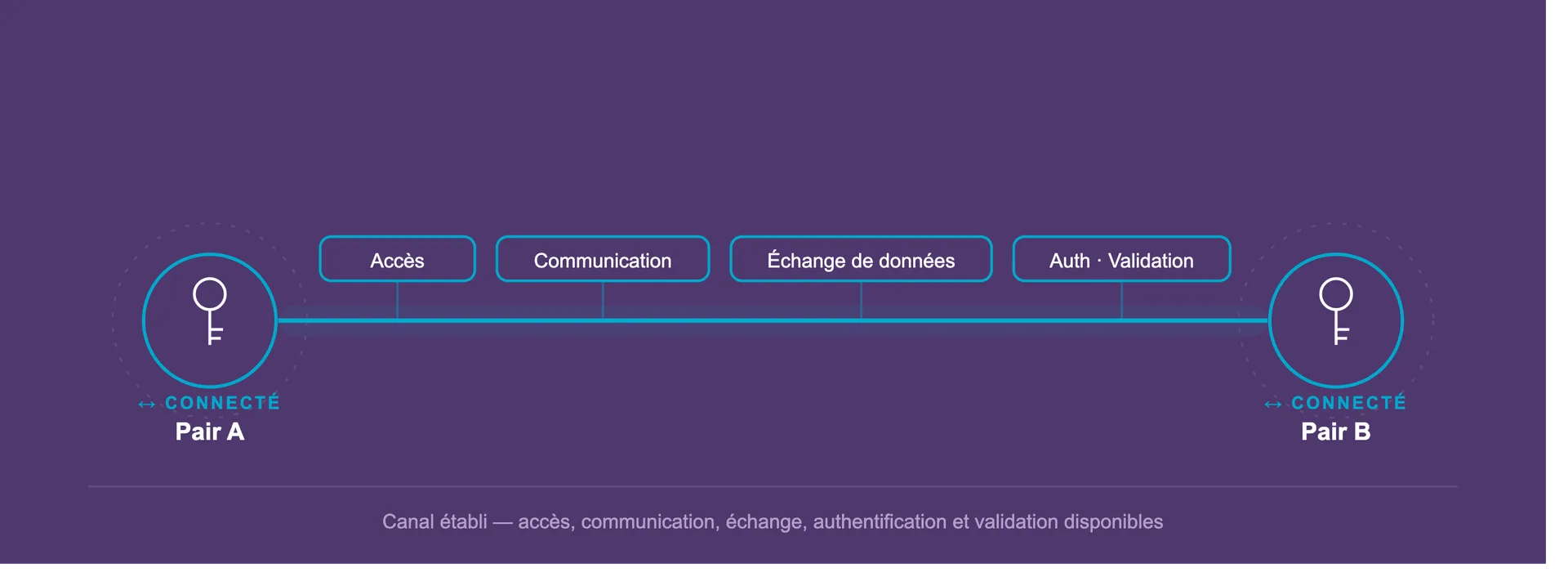
Identifiers and certificates are exchanged directly between the two parties.
Proof of possession
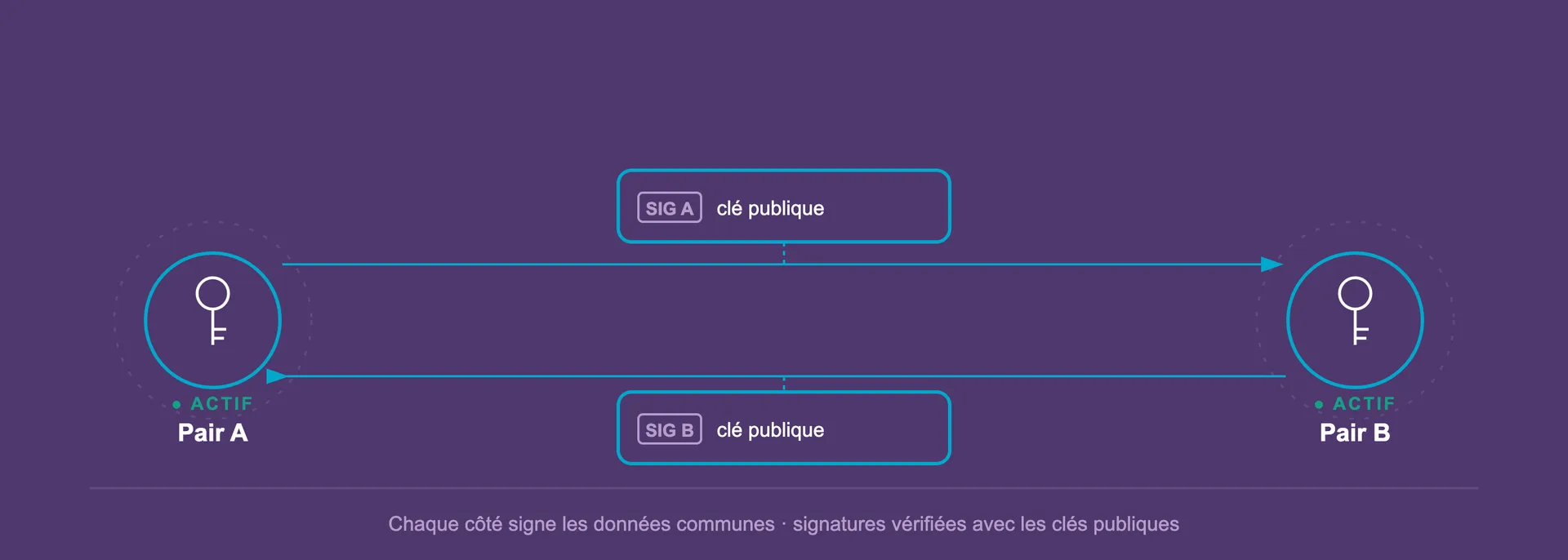
Each party signs the exchange data to prove that they possess the private key corresponding to their identity.
A two-step protocol.
Initial Handshake
The first meeting between two peers.
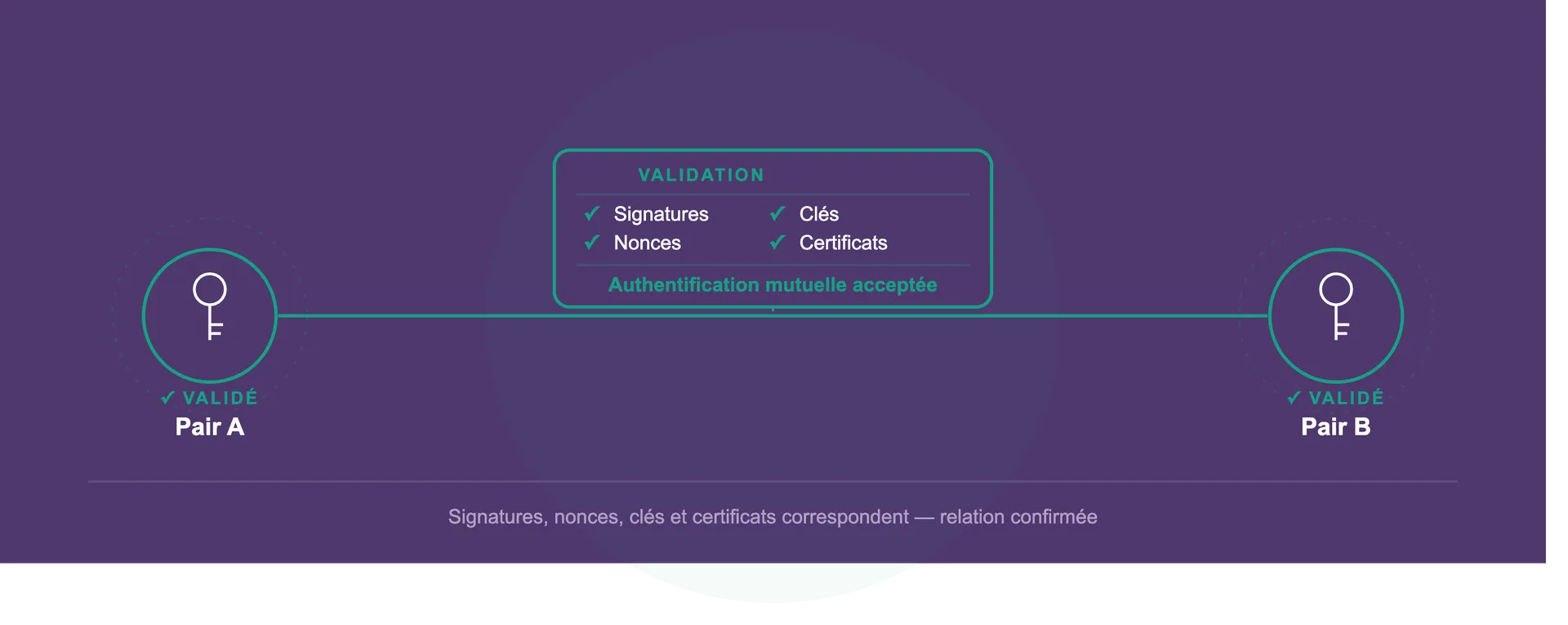
During this phase, both parties exchange their identifiers, including their public keys. Once the exchange is validated, each peer saves the other's identity in their personal directory.
Objective: establish an initial trust relationship between two identities.

The protocol does not exchange secrets. It exchanges proofs.
The VaultysID protocol relies on public key cryptography. The data exchanged is not used to reveal a secret, but to prove that each party truly holds the private key associated with their identity.

Credentials
They notably contain the peer's public keys.

Nonces
Unique values generated to make each interaction different and limit replay attacks.

Timestamp
Allows you to date the exchange and reduce the validity window of a message.

Signatures
Each peer signs the exchange data to prove possession of their private key.

Local certificates
After validation, known identities are stored in each peer’s personal directory.
ALMOND states that nonces make the interaction unique, the timestamp limits replay attacks, and signatures allow each party to verify that the other holds the private key corresponding to the exchanged identity.
A decentralized identity model, without a central authority.
At Vaultys, Web3 is not just a slogan. It’s an identity architecture.
The protocol does not rely on a central database holding all identities. Each user, device, or service can carry its own cryptographic identity, directly verifiable by other peers.
This approach enables the creation of systems where trust is distributed, where identity remains controlled by its holder, and where compromising a central server is not enough to compromise all identities.
DID-based identity
Each peer can be identified by a decentralized identifier.

No central authority
Trust does not depend on a single identity provider.
Peer-to-peer authentication
Identities are verified directly with each other.
User-controlled identity
The identity is carried by the user, the device, or the service.

Passwordless by design
Cryptographic proof replaces the password.
Vaultys introduces VaultysID as a decentralized identity system with DID, passkeys/FIDO2, and passwordless authentication.
From access request to verified trust.
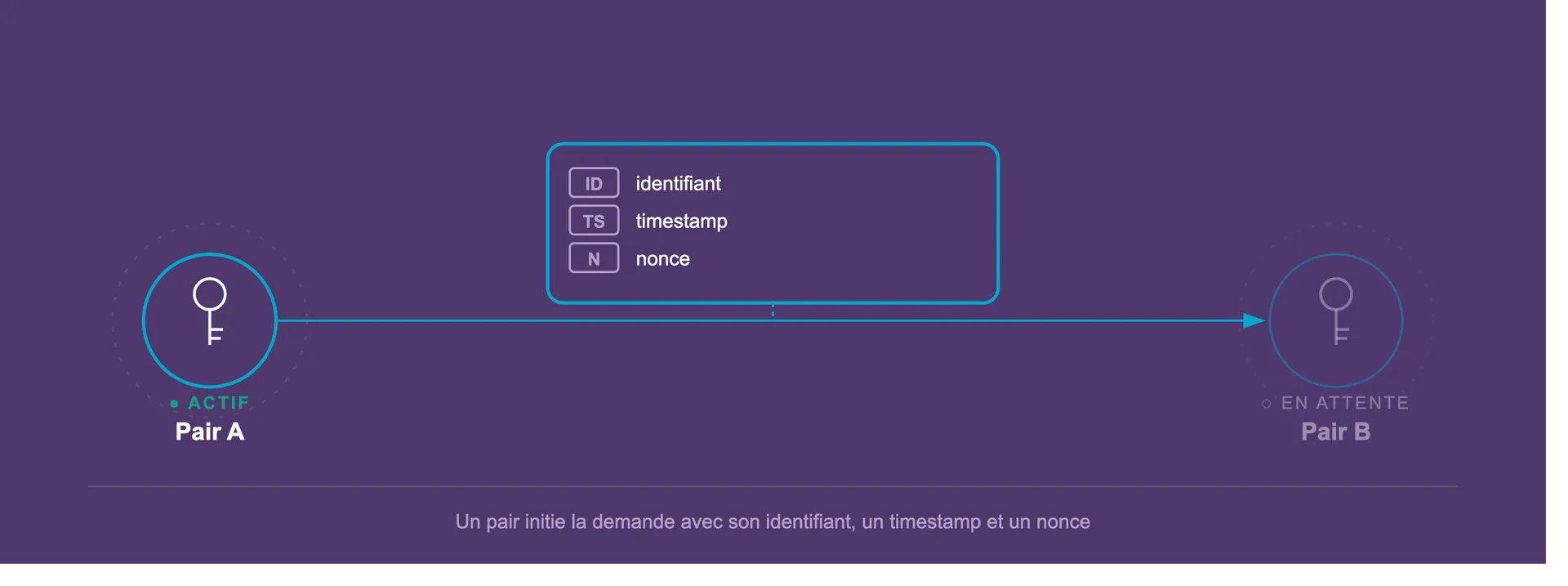
The peer initiates the connection
A peer initiates the request with its identifier, a timestamp, and a nonce.
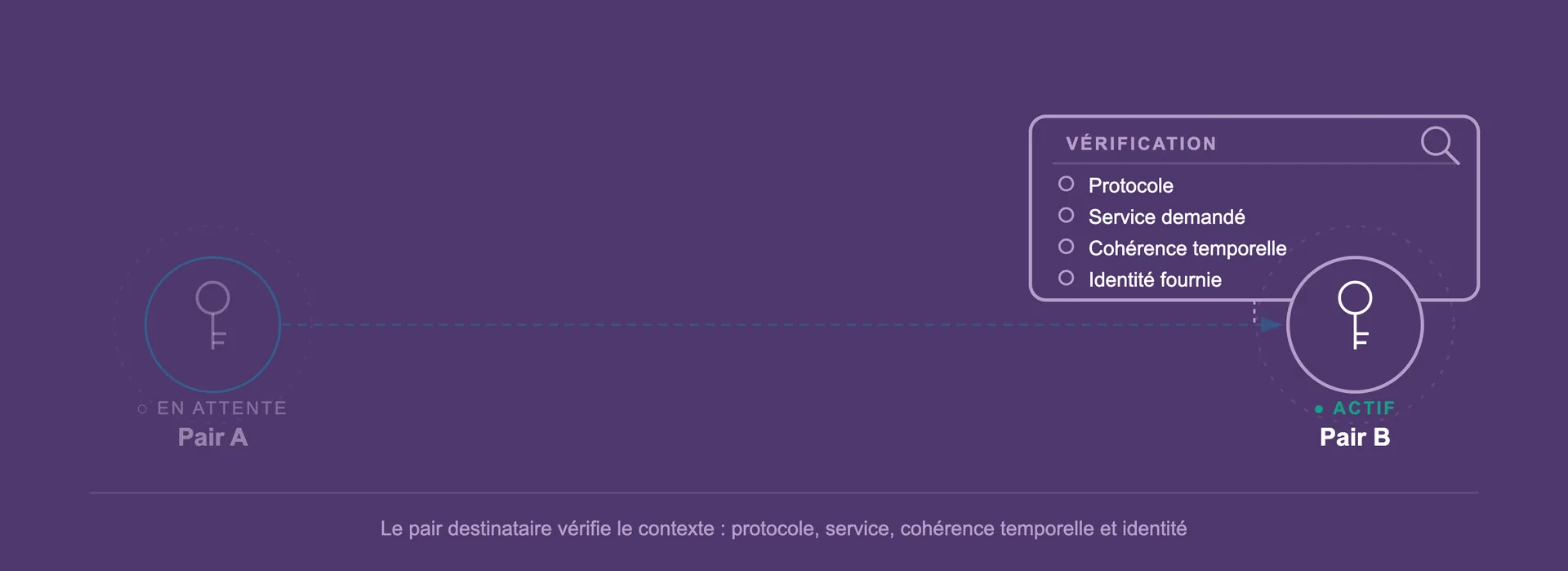
Local, verifiable, and distributed trust.
In TLS, trust is generally based on pre-established root authorities. In VaultysID, initial trust is created during the first exchange between two peers, then maintained in their personal directories.
This model brings VaultysID closer to a modern Web of Trust: identities are not only validated by a central authority, but also through cryptographic relationships established between peers.
Authentication designed to resist replay and impersonation
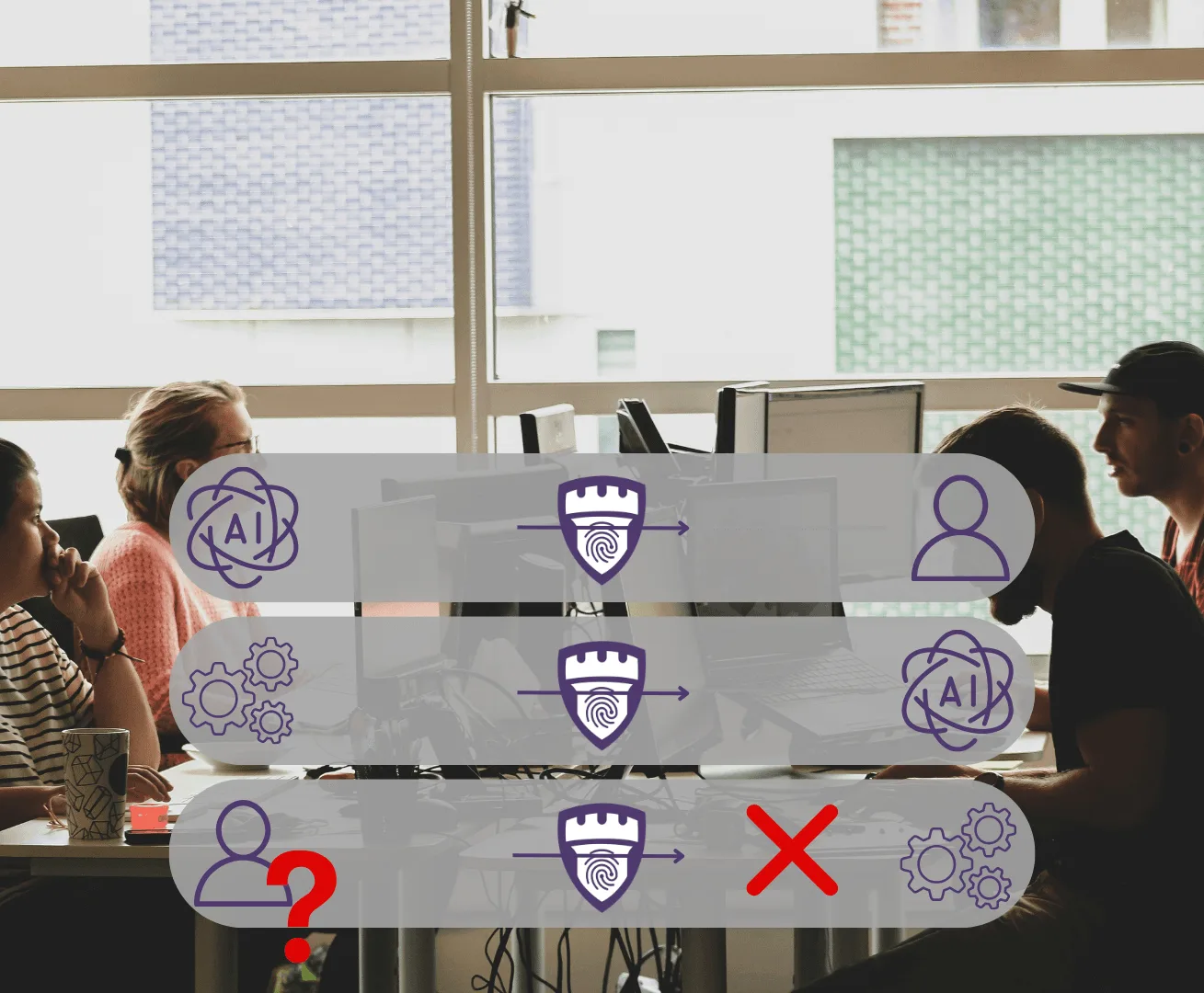
The VaultysID protocol secures every exchange by relying on cryptographic proofs rather than trust in a central third party. Each authentication is based on a unique exchange between two peers, using nonces, timestamps, and signatures that verify the true identity of the counterpart.
In practical terms, an old message cannot be replayed in a different context, an identity cannot be impersonated without its private key, and any modification of the exchanged data immediately invalidates the verification. The result is simple: trust no longer depends on a central directory, it is established directly between the two peers at the time of exchange.
A technical foundation for sensitive use cases.
The VaultysID Web3 / P2P protocol can serve as an identity layer for different environments:
User authentication
Passwordless login to an application or service.
Machine-to-machine authentication
Cryptographic verification between devices, servers, or services.
AI agent authentication
Assigning a unique identity to an autonomous agent to verify who is acting, in what context, and with what rights.
Decentralized access control
Identity validation without concentrating all secrets in a central directory.
Peer-to-peer trust relationships
Creation of cryptographic relationships between users, devices, or organizations.
Build on an identity that does not rely on a central point.
The VaultysID protocol provides a P2P authentication foundation to create applications, services, and infrastructures where each identity can be cryptographically verified, without passwords and without a single central authority.